What if your client could see your advice in the moments they need it?




Transform your coaching with Client Insights, Coaching Cues, and Continuous Evaluation
Pinpoint the critical moments in your client's lives.
Walk in already knowing where the week turned.
Your client's calendar, with the state they were actually in underneath it. Before you ask a single question, the ninety minutes of red under a named meeting is already in front of you.
Ask about Wednesday, 11:30am.
The CuesHub Advantage
See the pattern, find the trigger.
Once you see the pattern, you can help your client discover the moments and situations that trigger them.
Every Tuesday, at the same hour
What your client calls “a busy period” turns out to be the same hour every week, and often nothing on the calendar at all.
Book a founding spotHave your clients cued to practice your coaching at the right moments.
Cues to help your clients practice your coaching.
Your executive leaves the session clear, motivated, and genuinely intending to change. Then the week starts. The moment the new behavior was meant for arrives on a Tuesday afternoon, mid-escalation, and they don't even realize it. Naturally, they don't mention it in the next session.
Behavior change needs a cue. You already deliver everything else.
BJ Fogg, Stanford Behavior Design Lab
They want to change. That's the work you did in your session.
You showed them what to change and how to do it.
The prompt to practice at the right moment is the missing piece.
CuesHub delivers the missing cue.
The CuesHub Advantage
Your personalized coaching at the right moment.
You write the cue. CuesHub waits for the moment it was written for: sustained strain, a spike out of nowhere, the third hard hour in a row. Your words arrive when they're needed the most.
Sustained strain, mid-afternoon. Your client can see it. You cannot.
The cue you wrote, delivered at the moment it was written for.
You write the cues
Every client gets their own. Write what you would have said if you were in the room, and choose the moment it should reach them.
Find the personal advice that fits each client faster with continuous visibility.
Visibility between sessions to know what is working and how well.
Every engagement is an experiment with a sample size of one. You form a hypothesis about this person, you give them something to try, and then you wait a month to hear how it went from someone who was busy living it.
Personalization needs evidence. You already bring everything else.
n-of-1 methodology · precision medicine
You know this person: their pressures, their patterns, what they'll actually do.
You give them something specific to try this week.
You wait until the next session to find out how well it worked, from your client's memory.
CuesHub delivers the missing evidence.
The CuesHub Advantage
You have the intuition, we bring you visibility.
Now you have full visibility into what is working and what needs improvement before you meet.
The marker is your session
Everything to the right of it happened after you worked together. The trend either moves or it doesn’t, and you will know which before they do.
Book a founding spotZero burden for your clients.
Your client installs the app and connect their calendar. You start seeing patterns for the past month.
Try for two months, risk-free.
Define the next frontier of coaching.
Who we are looking for
You are coaching executives now, not building toward it.
At least a few already wear an Apple Watch Series 6 or newer, or a Galaxy Watch 4 or newer.
You intend to put this in front of real clients, not just test it on yourself.
What you get
- Continuous client visibility
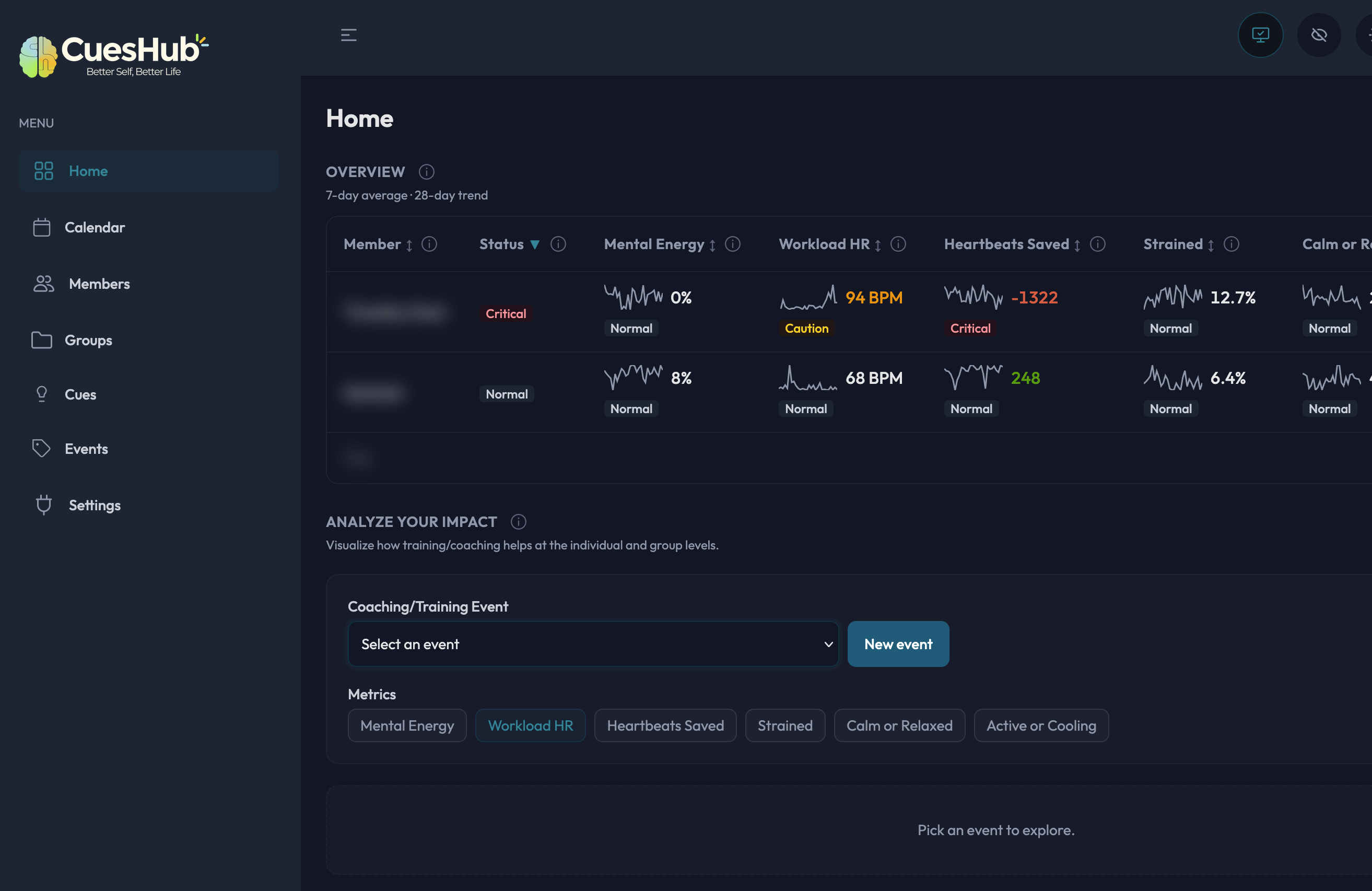
Hourly heatmap, daily trends, and what was happening when strain spiked.
- Check-in tracking
Quickly know which clients are doing well, who needs a check-in, and why.
- Proof between sessions
Measure the effect of your coaching on their strain and recovery.
- Weekly conversation with the founders
Get insights and support to get the most out of you pilot.
What your clients get
- Premium app access, included
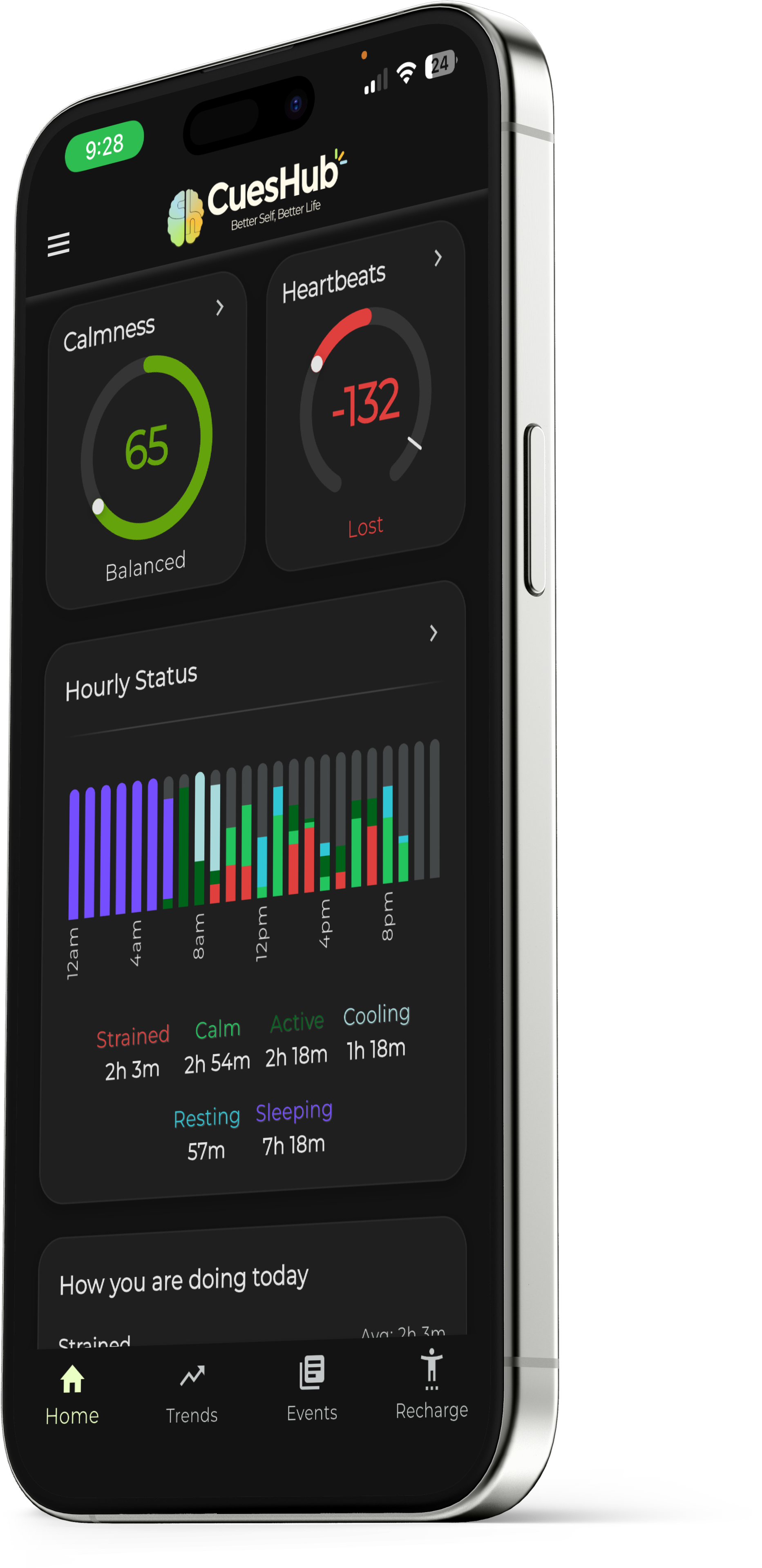
Live tracking of mental state, their own patterns, predictive nudges, and more. Nothing extra for them to buy.
- Your cue, delivered at the right moment
Reminders to practice your coaching when it matters.
What we ask in return
- Anonymized outcome data
Aggregate patterns from your engagements
- Testimonials
Permission to name you as a founding coach and to quote you, with approval over the wording.
The walkthrough demo
We spend 30 minutes on your own data to help decide if this is a mutual fit.
- 1Wear a watch, if you have one
An Apple Watch or Galaxy Watch for about a week makes the walkthrough yours. If you don't, we'll use our own data.
- 2Join a coaching group
Experience how easy it is for your clients to join your coaching group.
- 3The coach's view
Everything you'd see about a client, showing your data instead.
- 4Customized cue delivery
Write a cue in your own words and feel it arrive at the moment it was meant for.
- 5Decide together
If it's a fit on both sides, we walk through your founding terms and put them in writing.
Founding coach benefits
Complimentary onboarding and training
1:1 support with a co-founder to customize your client pitch
Founding coach referral program
Discounted pricing during the pilot
After the two-month pilot
Not satisfied? Full refund. No questions.
Schedule a walkthroughNo obligation on either side after the walkthrough.



Questions.
What is the science behind CuesHub?
Eighteen years of deep research powers CuesHub's AI. The research was led by CuesHub's CEO, who is the director of two NIH-funded national research centers in this field, MD2K and mDOT. Learn more about the science behind CuesHub.
Do I see my client's data in real time?
No. Live signals stay on your client's device, visible only to them. You see daily patterns, afterwards, with their consent. There's also no audio, no video and no transcript. CuesHub reads physiological state, never the content of a session.
How is my client's data protected?
It is encrypted in transit and at rest, held against their account rather than your practice, and visible to you only for as long as they allow it.
What if my client withdraws consent?
Access ends immediately. They can do it themselves, without going through you or us, and they don't have to explain why.
What happens when a coaching engagement ends?
Your access ends with it. They keep their full app history, and it follows them wherever they go next.
Is this a clinical or diagnostic tool?
No. CuesHub reports physiological state (strain, recovery, mental energy) and makes no medical or diagnostic claims.
How do I onboard a new client?
You invite them to your coaching group from the dashboard. They install the app, connect the watch they already wear, and join the group. It takes a few minutes on their side, and their data appears on the coaching dashboard.
What device does my client need?
An Apple Watch Series 6 or newer, or a Samsung Galaxy Watch 4 or newer. Most executives already wear one. If yours doesn't, they'd need to get one. We don't supply hardware, and there's nothing for you to ship or manage either way.